


This article draws on Creative Navy's project work in industrial and embedded interface design, spanning industrial robots, plant floor equipment across food, pharmaceutical, chemical, and materials manufacturing, industrial automation and control software, CAD/CAM systems, IoT platforms, and simulation software. Our work in this sector covers control room environments, plant floor operations, clean room manufacturing, and field deployment conditions: designing for process engineers, plant operators, maintenance technicians, and automation engineers. We work within the standards frameworks that govern these environments, including ISA-101 for HMI design, ISO 13849 and IEC 62061 for machinery safety, and IEC 61508 functional safety requirements, treating these as structural inputs to the design process rather than compliance checklists.
Key Statistics
- 35% of all heat pump field problems in a 228-unit Swiss inspection study were attributed to the heating control system (Energy Informatics, 2022)
- 23% of consumers could successfully set a heating schedule in controlled testing, described by the SEAI as "one of the most basic and vital functions of any heating controller" (SEAI, 2022)
- 41% of monitored Swiss heat pumps had heating curves set too high at the time of the ETH Zurich study (May 2025)
- Correctly optimised heating curves produce an average 4.02% reduction in yearly energy consumption across a 3,995-unit monitored fleet (Applied Energy, March 2025)
- AI-controlled heating curves produced a 13% energy saving compared to static installer-set curves in Fraunhofer ISE field testing, with a 25% COP improvement in a one-week trial (December 2024)
- Samsung now holds approximately 15% of the UK heat pump market, on a par with Daikin and Vaillant (RenewableHeatingHub, 2024)
- Two-thirds of people who believed they understood their heating controls were operating them incorrectly, according to an Ipsos MORI survey (2014, cited by Passiv UK, 2024)
Every heat pump installed with a misconfigured heating curve costs its owner money each month. A peer-reviewed analysis of 3,995 domestic air-to-water units across ten Central European countries, published in Applied Energy in March 2025, found that correctly optimised heating curves would reduce annual energy consumption by an average of 4.02%. On a median unit consuming 5,150 kWh per year, that is approximately 206 kWh. Per unit. Every year. The study explicitly attributes persistent misconfiguration to interface design: heating curves "are set once during installation and have not been optimized for the building, as this is only achievable through a time-consuming calibration."
Heat pump user interface design
The cause of that gap is not technical. It is interface failure at scale. A government-commissioned experiment by the Sustainable Energy Authority of Ireland found that only 23% of participants could successfully set a heating schedule on a typical heat pump controller. The SEAI classifies schedule setting as "one of the most basic and vital functions of any heating controller." It is simpler than heating curve calibration by a significant margin.
Heat pump heating curve misconfiguration costs the average household approximately 206 kWh per year in unnecessary energy consumption. A peer-reviewed analysis of 3,995 domestic air-to-water units across ten Central European countries (Applied Energy, March 2025) found that correctly optimised curves would reduce annual energy consumption by 4.02% on average. The cause is not technical failure. Heating curves are set at installation by an engineer and are not subsequently adjusted because the interface is not navigable by the owner without specialist knowledge.
This benchmarking review covers the current state of heat pump controller UX across the leading manufacturers in the UK and European residential market, updated from an earlier benchmarking completed in February 2023. The evaluation covers both on-device hardware controllers and companion app interfaces, assessed against a single operational criterion: can a homeowner, without community guides or installer follow-up, configure and operate this system correctly? The audience is not a design team. It is a product director deciding where interface investment belongs before the mainstream adoption curve makes current controller failures a brand liability rather than a category norm.
What This Review Covers and How
The products reviewed here are: Daikin Altherma 3 and its ONECTA companion app; the Dimplex heat pump range (updated to touchscreen); the Mitsubishi Electric Ecodan FTC7 (which superseded the FTC6 reviewed in 2023); the LG Therma V across the R32 and R290 ranges; and the Nibe F370. We also cover two categories the 2023 benchmarking did not reach: the Vaillant aroTHERM and SensoComfort ecosystem, and the Samsung Gen 6 EHS Mono.
The evaluation framework applies three criteria:
| Criterion | What it tests |
|---|---|
| Core task completion | Can a homeowner set a heating schedule and adjust a heating curve without professional support? |
| System legibility | Does the interface communicate what the system is doing and why? |
| Error recovery | When something goes wrong, does the interface help the user understand and correct it? |
These are not aspirational UX standards. They are the minimum conditions for a product that is supposed to transfer meaningful control to its owner. Where they fail, the efficiency gap documented in the research above persists, compounding annually across every installation in the field.
Heat pump user interaction design
Daikin Altherma 3 and ONECTA
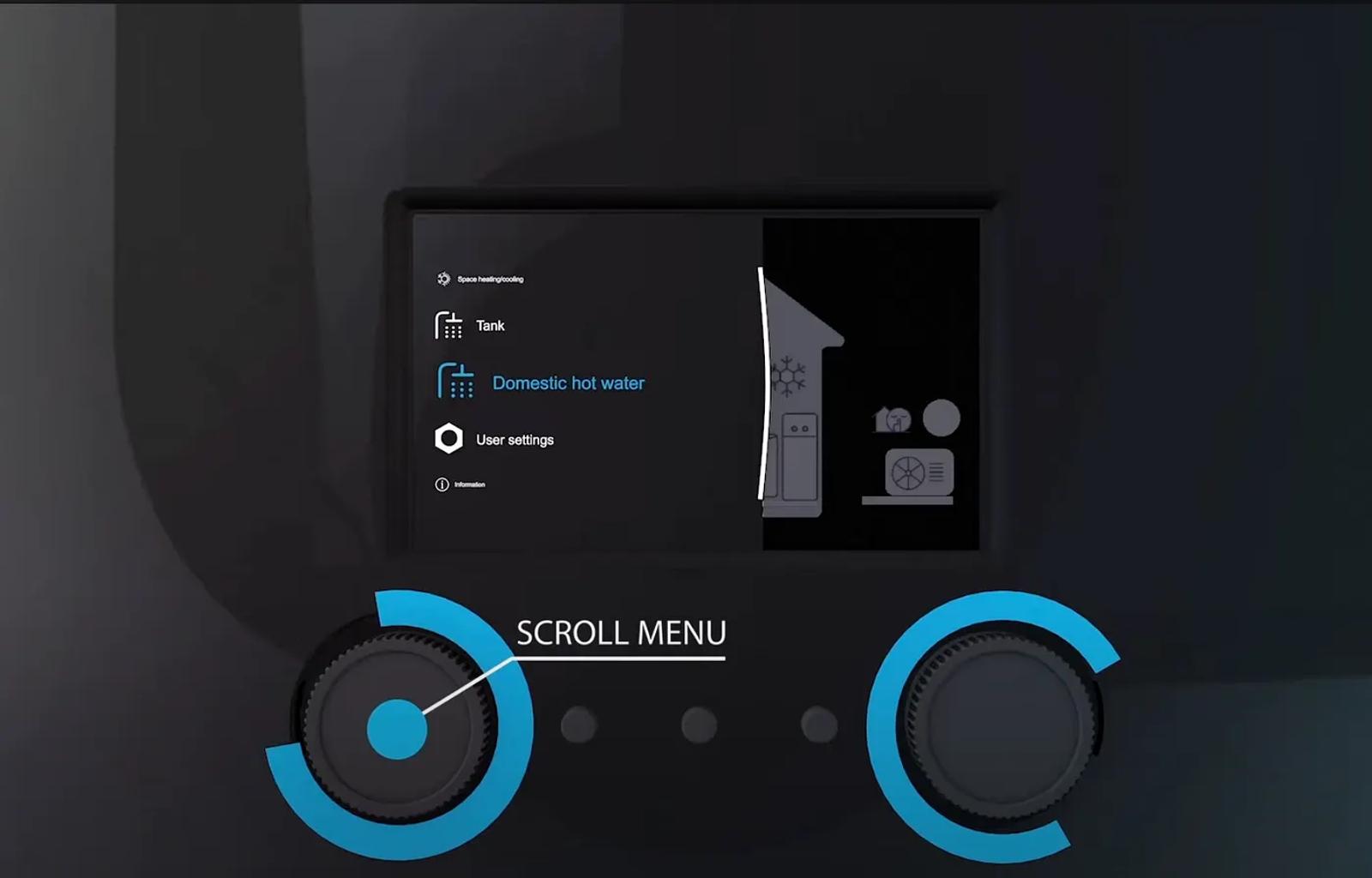
What has changed. Daikin discontinued the legacy Online Controller app in April 2024 and migrated users to the ONECTA app. ONECTA has received substantive UI updates through 2024 and 2025: improved onboarding for Altherma units, redesigned icons for cloud-disconnected states, an improved schedule interface, and improved energy consumption graphs (March 2025). The physical two-knob controller shipped with existing Altherma 3 installations has not been redesigned. A third-party route via the Daikin HomeHub now enables configuration of secondary heating circuits through the wibutler app without engaging the heat pump's control panel directly.
What has not changed. The physical controller's navigation architecture remains unchanged: unlabelled knobs, deep menu paths, and no direct path to zone-level settings from the home screen. The wibutler integration addresses one specific navigation pain point without altering the underlying system.
What the app layer reveals. App store reviews from 2024 and 2025 document a specific recurring failure: data loss after firmware updates. One Dutch-language App Store review describes losing device registration, consumption history, installation configuration, and installer data after every update, requiring full re-setup each time. A separate review documents being unable to verify key operating parameters, including inlet and outlet temperature, flow rate, and pressure, through the ONECTA app, and having to navigate to the physical unit's menu to check them. The friction is not aesthetic. It prevents remote monitoring, which is the primary reason most owners use a companion app at all.
What this reveals about the broader problem. Daikin has treated the app as the interface evolution layer while leaving the hardware controller unchanged. ONECTA's energy graphs now communicate consumption data. They cannot help an owner determine whether the heating curve generating that consumption is correctly set. Information is displayed. The understanding needed to act on it is not transferred. This is what sense decay looks like at the product level: the interface becomes progressively richer in visible data while the connection between that data and owner action weakens.
Dimplex
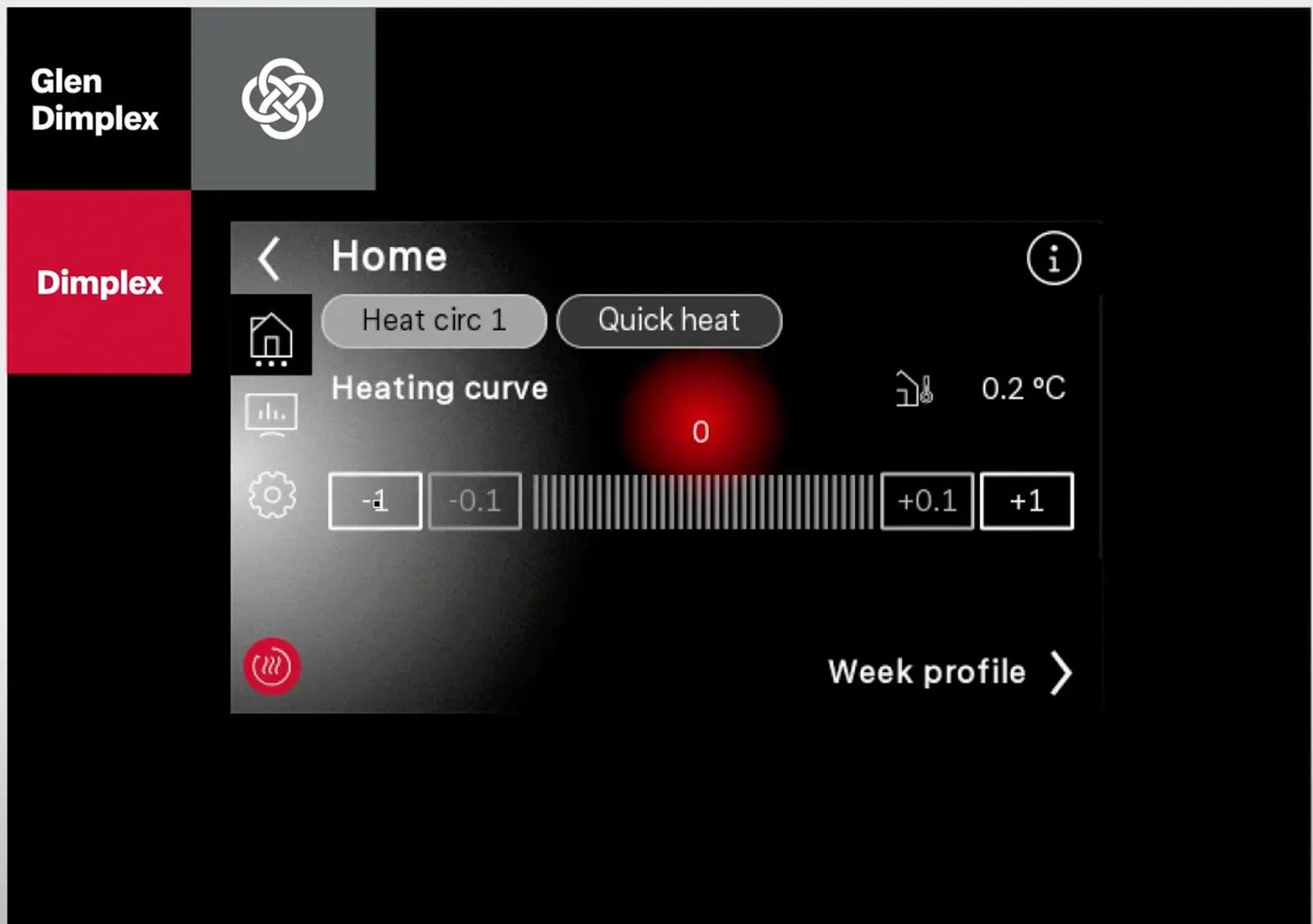
What has changed. The button-increment controller reviewed in 2023 is no longer the current product. Dimplex's System M Flex and related heat pump models now ship with a 4.3-inch colour touchscreen as standard, connected to the Dimplex Home App via the NWPM Touch network card to the Glen Dimplex Cloud on Microsoft Azure. The app supports control of up to 20 rooms.
What has not changed. No independent usability assessment of the new touchscreen was found. Dimplex describes it as "intuitive." That claim cannot be evaluated from available evidence.
What this reveals. A new screen and companion app constitute a redesign of the visible surface. The 2023 benchmarking identified problems that were structural: mixed information hierarchy presenting settings and temperatures without clear organisation, non-standard increment controls, and hidden tap-to-edit interactions in weekly profiles. Whether a touchscreen resolves any of these depends entirely on the navigation model behind it. The hardware upgrade is real. Whether the UX improvement is equivalent requires independent assessment that has not yet been conducted.
Mitsubishi Electric Ecodan
What has changed. The FTC6 has been superseded by the FTC7, which includes a colour touchscreen, one-touch settings access, a step-by-step installation wizard, Smart Grid and PV integration readiness, and built-in energy monitoring. Mitsubishi confirms the FTC7 is the controller supplied with its R290-compatible pre-plumbed cylinder range.
What has not changed. The architectural UX weaknesses documented in the FTC6, specifically the confusing Holiday mode activation requiring a long-press distinguished from a short-press on the same button, context-shifting soft-button labels that changed function depending on the current screen, and manual dependency for mode switching, were structural to that generation. Whether the FTC7 resolves them is unknown. Vendor documentation describes features, not behaviour under realistic use conditions.
What the history reveals. The FTC6's soft-button design placed label text above on-screen icons, then shifted those labels according to context. A user who had learned a button's function in one menu screen could not rely on that function in another. That is a navigation model problem. Adding a colour touchscreen addresses the display constraint. It does not, by itself, correct the underlying mapping problem between controls and actions. The FTC7 may have solved this. The evidence to confirm it does not exist in the public domain.
LG Therma V
What has changed. LG introduced the Therma V R290 Monobloc range, with 7 and 9 kW models announced at IFA 2024 following 12 to 16 kW R290 models at IFA 2023. Marketing emphasises the BECON cloud platform for remote firmware updates by installers.
What has not changed. The physical controller hardware for existing Therma V R32 installations has not received a UI redesign. Forum evidence from RenewableHeatingHub (most recent post August 2025) confirms some users are still running controller software versions from 2020. The bubble-menu navigation identified in 2023, which requires serial scrolling with no overview of connected devices, remains unaddressed in available documentation for existing units.
What a specific failure reveals. The OpenEnergyMonitor community hosts a fifth-edition user guide for configuring weather compensation on the LG Therma V. The guide exists because LG's label for the weather compensation feature is "AI," with no explanation of what the feature does or how to configure it. The guide advises owners to keep a list of current settings before making changes. This is not an edge case. Weather compensation is a core efficiency mechanism. A fifth edition of a community guide covering a fundamental configuration task, written because the manufacturer's interface does not make that task navigable, is direct evidence that the interface has transferred the burden of understanding to installer networks and owner communities rather than carrying it within the product.
Nibe F370
What has changed. Active firmware development continues. Releases through October 2024 added myUplink integration, Nord Pool electricity price zone support, additional language coverage, and SAM accessory communication fixes.
What has not changed. The lid-based progressive disclosure design, the knob-and-button navigation, and the four-square menu structure are unchanged. The unlabelled dial, identified in 2023 as a usability risk for value-setting tasks where accidental overshoot is likely, remains unlabelled. No navigation or interaction changes appear in the firmware changelog reviewed, which covers releases through October 2024 (last revised October 2025).
What this reveals. Nibe's lid design does something architecturally useful: it separates ambient status display from configuration access, which reduces the cognitive load of routine checking. That decision has been preserved across the product's update cycle and represents a genuine constraint respecting choice given the hardware's real estate limitations. The myUplink platform increasingly offsets on-device navigation friction for connected users. The unlabelled dial is an unresolved tension in the design. It is genuinely unclear whether the physical constraint makes it irresolvable, or whether the team has absorbed the known usability cost as acceptable given the dial's infrequent use for value setting.
Vaillant and Samsung
Vaillant aroTHERM. Vaillant's heating-curve configuration via the SensoComfort controller was sufficiently complex that the company introduced a simplified heat curve adjustment interface in the myVaillant app in October 2024. A practitioner blogger described the update as meaningful progress. The significance is not the feature itself. It is what the feature's introduction confirms: the original configuration path was not working, and the manufacturer knew it. An interface update driven by documented user failure is a better signal than a feature update driven by a product roadmap.
Samsung Gen 6 EHS Mono. Samsung holds approximately 15% of the UK market as of 2024. No independent UX benchmarking of the Gen 6 controller was found. Forum evidence from earlier Samsung heat pump generations documents a persistent pattern: users who inherit a system find two controllers with no documentation and no interface-level explanation of which controller manages heating versus domestic hot water. This is the same icon-without-label failure identified across the 2023 benchmarking. Unlabelled controls with no contextual guidance are a structural problem, not a cosmetic one, and there is no available evidence that the Gen 6 has resolved it.
What the Pattern Reveals
Across every product in this review, the same sequence appears. The physical controller was designed for an installer performing a commissioning visit. The companion app was designed for a correctly commissioned system used remotely. Neither was designed for an owner who needs to understand, interrogate, and periodically reconfigure a system they interact with across years of operation.
| Product | Physical controller updated? | App or connectivity updated? | Structural UX issues resolved? |
|---|---|---|---|
| Daikin Altherma 3 | No | Yes (ONECTA 2024/25) | No |
| Dimplex | New hardware | Yes | Unknown |
| Ecodan (FTC6 to FTC7) | New hardware | N/A | Unknown |
| LG Therma V | No | BECON (R290 range) | No |
| Nibe F370 | No | myUplink | No |
| Vaillant aroTHERM | No | Simplified heat curve added Oct 2024 | Partially |
| Samsung Gen 6 | Unknown | Unknown | Unknown |
Where investment is visible, it is in the app layer and connectivity infrastructure. The navigation model and information architecture of the device the homeowner touches daily have not materially changed across the products where evidence is available.
Heat pump controller UX is what misconfigured efficiency looks like at scale: a system that performs well in specification and underperforms in practice. The gap between the two is the interface. A peer-reviewed analysis of 3,995 units found a 4.02% average annual efficiency loss from heating curves that were set at installation and never subsequently adjusted, because the adjustment interface is not navigable by the owner. That figure is not a usability concern. It is a product performance gap that appears in every installed unit whose heating curve has never been touched.
In projects involving embedded device interfaces with similar patterns, the finding that consistently surprises product teams is how much of their post-installation support load traces directly to configuration tasks that the interface never equipped the owner to perform. The calls come in framed as device faults. The root cause, on investigation, is a setting that was never set correctly because the path to set it was inaccessible without specialist knowledge.
Why Apps Alone Will Not Close the Gap
The standard counterargument is that the app layer is the right place to solve controller UX. Physical controllers have screen size constraints, limited input mechanisms, and manufacturing cost pressure. Apps have none of these. If heating curve configuration is unclear on the physical unit, move it to the app, add explanatory text, and the problem is solved.
Transfer of understanding is the design problem, not presentation of information. Setting a heating curve correctly requires an owner to understand the relationship between flow temperature and outdoor temperature, to know their building's thermal characteristics, and to recognise when a curve is underperforming. Moving a complex configuration task to a larger screen does not reduce its complexity. It relocates the friction while adding a dependency on app connectivity that rural and older demographics may not reliably have.
The Usability Renewal Cycle framework for professional device interfaces applies directly here: every heat pump controller in this review has accumulated interface drift across its product lifecycle. The heating curve screen that confused an installer during a commissioning visit in 2019 remains, structurally, the same screen in 2026. App investment is not renewal; it is patch. The underlying model has not been rethought.
The Fraunhofer ISE AI4HP project finding points to a more defensible path. AI-controlled heating curves, where the system observes its own performance and adjusts without requiring owner comprehension of the underlying physics, produced a 13% energy saving versus static installer-set curves in field testing (December 2024). That replaces the comprehension burden with system autonomy. Whether owners will accept a heating system that adjusts itself without explaining why is a question this review cannot settle. The trust design required for that kind of autonomous operation is substantially different from anything currently visible in this product landscape. It is a genuinely open question whether it will arrive via the HVAC manufacturers or via third-party home energy management platforms.
An industry analysis published in January 2025 by ILLUME Advising for a US utility programme (Mass Save) documented units installed as primary heat sources being operated below capacity because owners were not using the integrated controls. The energy efficiency case for heat pumps was not being realised in the field because the interface sat between the user and the system's potential. That is a direct business cost, visible in follow-up call volume and customer satisfaction scores, before it appears in any efficiency metric.
The Competitive Vector
Heat pump owner satisfaction, measured by community surveys on the RenewableHeatingHub in August 2025, breaks down primarily around controls, third-party integration, and data visibility. Controls are listed first. In a category where installer and owner recommendations still dominate purchasing decisions, being the brand whose controls work without a fifth-edition community workaround is not a marginal advantage.
The owners entering the mainstream market in 2026 are not early adopters with technical confidence and forum memberships. They are the median homeowner: literate with smartphones, unfamiliar with flow temperatures, and without an installer relationship to call when something appears wrong. The interface that serves a commissioning engineer does not serve this user. The brands that close the comprehension gap, not just the configuration gap, will earn an advantage that compounds as the market scales.
Heat pump manufacturers lose their competitive standing the moment their controller becomes the subject of a multi-edition community workaround guide. An owner who requires that guide to configure weather compensation is not a power user failing at an advanced task. They are a mainstream customer failing at a basic one. The brand that makes core configuration tasks self-serviceable without community scaffolding will reduce post-installation support costs and build the referral reputation that drives purchasing in a category still dominated by installer and owner recommendations.
Closing that gap requires asking a different question than "which feature do we add to the app." The right question is: does the owner, at the end of a heating season, understand why their system performed the way it did? If they cannot answer it, every energy graph and usage dashboard in the companion app is information without meaning.
For embedded systems that have accumulated years of feature additions across hardware generations, that question requires the kind of structural audit that the When Is the Right Time for a GUI Redesign framework is built to support. The interface debt across this product landscape is architectural, not cosmetic. Addressing it at the surface produces the Dimplex result: a new screen with unknown UX properties because the underlying information architecture has not been assessed.
The organisations willing to treat embedded GUI design as a primary engineering constraint, on a par with thermal efficiency and hardware certification, will find themselves with products that require fewer post-installation support calls, generate fewer community workaround threads, and convert owner confidence into referrals. Heat pump controller UX is currently a collective failure that benefits no single manufacturer. The first product team to treat it as infrastructure rather than afterthought will have a clear run.
Heat pump controller UX is a business problem. The misconfiguration cost is real, it is measurable, and it is sitting in every installed unit whose heating curve has not been touched since the commissioning engineer left.
Limits and Gaps
Several assessments in this review are based on product documentation, specialist forum evidence, and app store records rather than independent usability testing. The Dimplex new touchscreen, the Ecodan FTC7, and the Samsung Gen 6 EHS Mono have not been independently benchmarked against the task-completion criteria applied here. Vendor claims describe features; they do not confirm operational performance under realistic use conditions.
The business impact figures cited here, specifically the 4.02% annual energy saving from optimised heating curves and the 35% of field problems attributed to heating controls, come from European study populations in Switzerland and Central Europe. These may not translate directly to UK housing stock characteristics, installation quality variation, or owner demographic differences. The direction of effect is consistent across independent studies; the magnitude should be treated as indicative rather than precise.
The Fraunhofer ISE AI4HP finding covers a limited field test and cannot yet be treated as evidence of population-scale performance. The interaction design requirements for AI-managed heating systems, specifically how to build owner trust in a system that adjusts itself autonomously, are not addressed by this review. They represent the most significant open question in the next generation of this product category.
App store reviews used as evidence in the Daikin section are individually unverifiable. They are included because they describe specific, concrete workflow breakdowns rather than general dissatisfaction, and because their described failure mode, data loss requiring full re-setup after firmware updates, is structurally plausible given how cloud-connected device synchronisation works.
Conclusion
Across six product families and three years of market development, heat pump controller UX has improved at its surface and stagnated at its structure. Companion apps have new features. Physical screens have higher resolution. The heating curve that determines whether an installed heat pump performs to specification remains set once by an installer and rarely adjusted again, because the interface that would allow an owner to adjust it is inaccessible to the 77% of users who could not complete a basic scheduling task in controlled testing.
The commercial framing for this problem is straightforward. A heating curve misconfigured by a few degrees costs roughly 206 kWh per year per unit. Multiply that across two million UK installations, and the aggregate inefficiency is both significant and preventable. The interface knows what the system is doing. It does not currently tell the owner in a way that allows them to act.
The market is at an inflection point. The owners arriving in the mainstream wave are not equipped to manage the interfaces they are inheriting. The brands that redesign for those owners, treating comprehension transfer as a primary engineering constraint, will earn a structural advantage that compounds as the category scales. The others will spend the next decade managing support call costs and forum reputation damage that is already clearly visible in the evidence reviewed here.
Frequently Asked Questions
What does a misconfigured heating curve actually cost per household? A peer-reviewed analysis of 3,995 heat pumps across ten countries (Applied Energy, March 2025) found that correctly optimised heating curves would reduce annual energy consumption by an average of 4.02%. On a median unit consuming around 5,150 kWh per year, that is approximately 206 kWh lost annually. The study attributes persistent misconfiguration to interface design: heating curves are set at installation and are not subsequently adjusted because the calibration process is not accessible to owners without specialist knowledge.
Why does the app layer fail to close the heat pump UX gap? App updates improve remote access and data visibility. They do not reduce the comprehension burden of core configuration tasks. Heating curve adjustment requires an owner to understand the relationship between flow temperature and outdoor conditions. Displaying that task on a larger screen does not simplify it. The SEAI 2022 study found only 23% of consumers could complete basic schedule setting, which is substantially simpler than curve calibration. The design problem is comprehension transfer, not screen size.
Which manufacturer shows the clearest improvement in controller UX since 2023? Vaillant's October 2024 introduction of a simplified heat curve adjustment interface in the myVaillant app is the clearest evidence of manufacturer-acknowledged UX improvement, because it represents product action in response to documented user failure rather than feature roadmap scheduling. LG and Daikin have the most substantively documented ongoing failures in available evidence. Dimplex and Ecodan have upgraded hardware that cannot be assessed independently.
What is the SEAI heat pump controls study? The SEAI (Sustainable Energy Authority of Ireland) commissioned Indecon Economic Consultants and London Economics to run a controlled experiment testing consumers' ability to operate heat pump controllers. Published in September 2022, it found that only 23% of participants could successfully set a heating schedule, which the report classifies as a fundamental task. The report made specific interface design recommendations to manufacturers and remains the most rigorous independent test of heat pump controller usability in the public domain.
What does the Energy Informatics field study show about control system failures? An analysis of 228 on-site heat pump inspection protocols in Switzerland (Energy Informatics, December 2022) identified 47 problem classes. The heating control system was the single most frequent problem component, accounting for 35% of all identified issues. Problems included incorrect heating curve settings, wrong heat limit values, and in some cases, interfaces that were not accessible for retrieving or changing settings at all. The study notes that resolving control-setting problems required energy consultants or specialist technicians rather than owner self-correction.
What is the Passiv Smart Thermostat and why does it exist? Passiv is a UK third-party heat pump controller manufacturer that launched in 2024 specifically to fill the gap created by manufacturer controller failure. Its commercial positioning cites the SEAI finding that only 23% of users can set a heating schedule, and argues that most manufacturer controls were designed for air conditioning or boilers and repurposed for heat pumps without redesign. The commercial viability of a purpose-built replacement controller is itself evidence of market failure: the primary manufacturer interfaces are sufficiently inadequate that a third-party business case exists to replace them.
References
Applied Energy. (2025, March 26). Optimization of heating curves for heat pumps in operation. Applied Energy. https://doi.org/10.1016/j.apenergy.2025.125725
Building Research & Information. (2018). Domestic demand-side response with heat pumps: controls and tariffs. Building Research & Information, 47(3). https://doi.org/10.1080/09613218.2018.1442775
CIBSE Journal. (2026, March). Heat pump performance and controls: findings from ASHRAE Winter Conference. CIBSE Journal. https://www.cibsejournal.com
Energy Informatics. (2022, December). Identification and classification of heat pump problems in the field. Energy Informatics, 5(Suppl 4). https://doi.org/10.1186/s42162-022-00250-3
ETH Zurich / Swiss Federal Office of Energy. (2025, May). AI in heat pump advisory services: findings from Swiss smart meter study. Bundesamt fur Energie. https://www.bfe.admin.ch
Fraunhofer ISE. (2024, December). AI4HP project: AI-controlled heating curves versus static curves. Reported in Pump Industry Magazine. https://www.pumpindustry.com.au
ILLUME Advising LLC. (2025, January). Heat pump and integrated controls performance review. Mass Save programme. https://www.illumeadvising.com
Passiv UK. (2024, June). Why heat pumps need smarter control. Passiv UK Insights. https://www.passiv.co.uk
RenewableHeatingHub. (2024/2025). Will heat pumps go mainstream in 2025 and are manufacturers failing homeowners with outdated controllers? Panel discussion recap. https://www.renewableheatinghub.co.uk
SEAI Behavioural Economics Unit. (2022, September). Consumers' ability to operate heat pump controls. Indecon/London Economics for SEAI. https://www.seai.ie/publications/Consumers-ability-to-operate-heat-pump-control.pdf
In this story
A benchmarking review of heat pump controller UX across seven major manufacturers, updated from 2023. Covers physical controllers and companion apps against three task-completion criteria. Finds that app-layer investment has not closed the structural gap between installed capability and owner operability.