This article draws on Creative Navy's project work in complex technical and scientific software, spanning computational fluid dynamics, surgery planning systems, scientific research software, CAD/CAM platforms, circuit simulation, vessel tracking systems, air traffic control, and mission control environments. We have designed for demanding technical experts such as CFD analysts, circuit design engineers, surgeons, air traffic controllers, mission controllers, and maritime operators. A central competency in this work is the visualisation of complex, dynamic, multi-dimensional data under real operational conditions, where clarity and precision directly affect decision quality. Several of these environments are governed by specific human factors standards, including EUROCONTROL and ICAO guidelines for ATC, IEC 62366 for medical software, and NASA requirements for mission-critical systems.
Up to 80% of engineering time in CFD workflows is still consumed by geometry preprocessing and meshing, not by simulation itself. This figure comes from Cadence Fidelity product documentation, confirmed across multiple publications from 2023 to 2025 (as of March 2026), and is cited widely across the industry without serious challenge, suggesting it reflects a practitioner reality rather than a marketing outlier. If the figure is approximately right, it means the simulation capability your organisation licences and supports is delivering full value for perhaps one day in five.
This is the commercial context in which CFD software interface design operates. A poor interface does not slow down engineers at the margins. It makes the product category structurally inefficient at its core function.
This benchmarking review covers the eleven CFD products examined in Creative Navy's 2022 analysis, updated against confirmed interface changes through March 2026, along with three new entrants that have positioned themselves explicitly against the UX failures of the established tools. The audience for this review is product directors and senior PMs who need to understand what the interface landscape is costing their organisations and where competitive advantage is actively being built by those willing to treat interface quality as infrastructure.
Key Statistics
- Up to 80% of engineering time in CFD workflows spent on preprocessing and meshing rather than simulation (Cadence Fidelity product documentation, 2023 to 2025, as of March 2026)
- Honda Motor Co. reported more than 90% reduction in preprocessing lead time and work hours after adopting automated meshing tooling (Cadence customer case study, 2025)
- Bühler Group extended CFD and FEA access to 15% of mechanical and process engineers across 25 departments after deploying SimScale's cloud platform, attributing development timeline savings of "weeks or months" (SimScale case study, 2025)
- The global CFD software market was valued at $2.4 billion in 2024, projected to reach $6.8 billion by 2033 at a 12.3% CAGR; the services segment (training, support, and customisation) is the fastest-growing component, a proxy indicator for ongoing onboarding friction across the industry (Market Intelo, September 2025)
- Y Combinator-backed Navier AI, founded by former SpaceX engineers, articulates the CFD market failure as: "today's engineers would rather build and test a physical prototype than simulate it" (Navier AI YC profile, accessed March 2026)
Poor UX in CFD software concentrates its cost in preprocessing, not in simulation runtime. Up to 80% of engineering time is spent on geometry cleanup, boundary condition setup, and meshing rather than on simulation itself. This cost is determined by how well the interface supports the engineer's actual sequence of work. Faster computation does not reduce it. Better interface design does. Honda Motor Co. reduced total preprocessing time by more than 90% through automated meshing tooling, indicating the recoverable scale.
How We Evaluated the Landscape
The Workflow Integrity Standard
Our evaluation applies the Workflow Integrity Standard: a four-dimension assessment of how well each product's interface supports the actual sequence of work engineers perform, rather than the sequence of functions the software exposes.
The four dimensions are: navigation coherence (whether the interface structure reflects the CFD process rather than the underlying software architecture); workflow continuity (whether engineers can progress through a simulation cycle without being forced to restart, switch tools, or lose setup work); constraint transparency (whether the interface communicates its own capability limits before the user has invested significant time); and capability gradient (whether the product can serve both experienced users and engineers transitioning from adjacent tools without collapsing into complexity for the former or inaccessibility for the latter).
These dimensions correspond to the failure modes that appear most consistently in practitioner accounts. A verified Capterra reviewer describing Ansys Discovery captured the workflow continuity failure precisely: after spending several days completing a simulation setup, support informed him that the specific analysis he needed required starting over from scratch in Fluent. The interface never communicated the boundary before the investment was made. The setup time was lost twice.
The following sections assess each product against these four dimensions. Where public evidence is insufficient to determine changes since December 2022, assessments reflect the last documented state.
ANSYS Fluent: Real Progress
ANSYS Fluent has undergone the most extensively documented interface evolution of any product in this review. In 2024 R1, Ansys introduced the Ansys Design Language (ADL) as a deliberate cross-product UX standardisation effort, targeting the inconsistent interaction conventions that existed between Fluent, Mechanical, and other tools in the suite. An Ansys UX lead publicly framed the starting point as "getting that consistent feel," citing different rotation behaviour between Fluent geometry and Mechanical as a known pain point (Ansys blog, June 2024).
ADL also delivered dark mode in 2024 R1 and a browser-based Fluent Web UI for remote job monitoring, result visualisation, and shared access with limited permissions. In 2025 R2, an AI documentation assistant (CoPilot) was integrated to surface contextual answers from Ansys documentation without requiring users to leave the application.

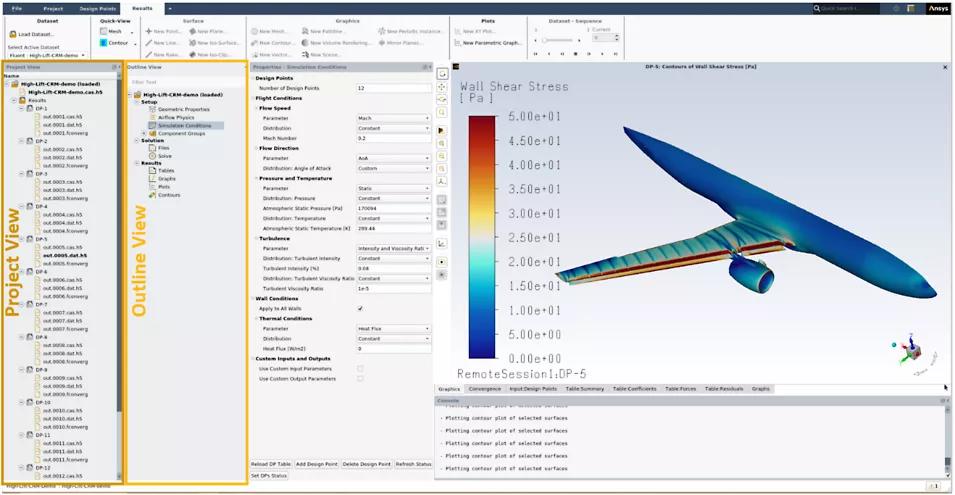
User interface of Ansys Fluent CFD software
The CoPilot integration addresses a specific and documented cost. When support questions require users to leave the application, search community forums, and wait, in some accounts up to a month, for a resolution, the interface is imposing a per-confusion cost in lost time. An embedded documentation layer changes that economics directly.
Against the Workflow Integrity Standard: navigation coherence has improved through ADL; capability gradient remains strong across user types; constraint transparency has improved through AI integration. Workflow continuity remains a documented tension in the Discovery-to-Fluent transfer path, which ADL does not yet resolve.
SimScale: Structural Change
SimScale has made the most structurally significant interface change of any cloud-based product in this review. The previously separated three-tab workflow, organised around meshing, simulation, and post-processing, has been consolidated into a single top-to-bottom workflow tree. Floating settings panels now expand to allow the viewer to occupy the majority of screen real estate.
This change directly addresses navigation coherence. The earlier tab model organised the interface around the software's internal architecture rather than the engineer's decision sequence. The workflow tree organises it around what the engineer needs to decide next.
SimScale also introduced AI-driven surrogate models and an engineering AI agent for workflow automation in 2025, with a stated aim of performance parity with desktop applications. The Bühler case study confirms a concrete organisational outcome: 15% of mechanical and process engineers with CFD and FEA access across 25 departments, with development timelines reduced by "weeks or months."

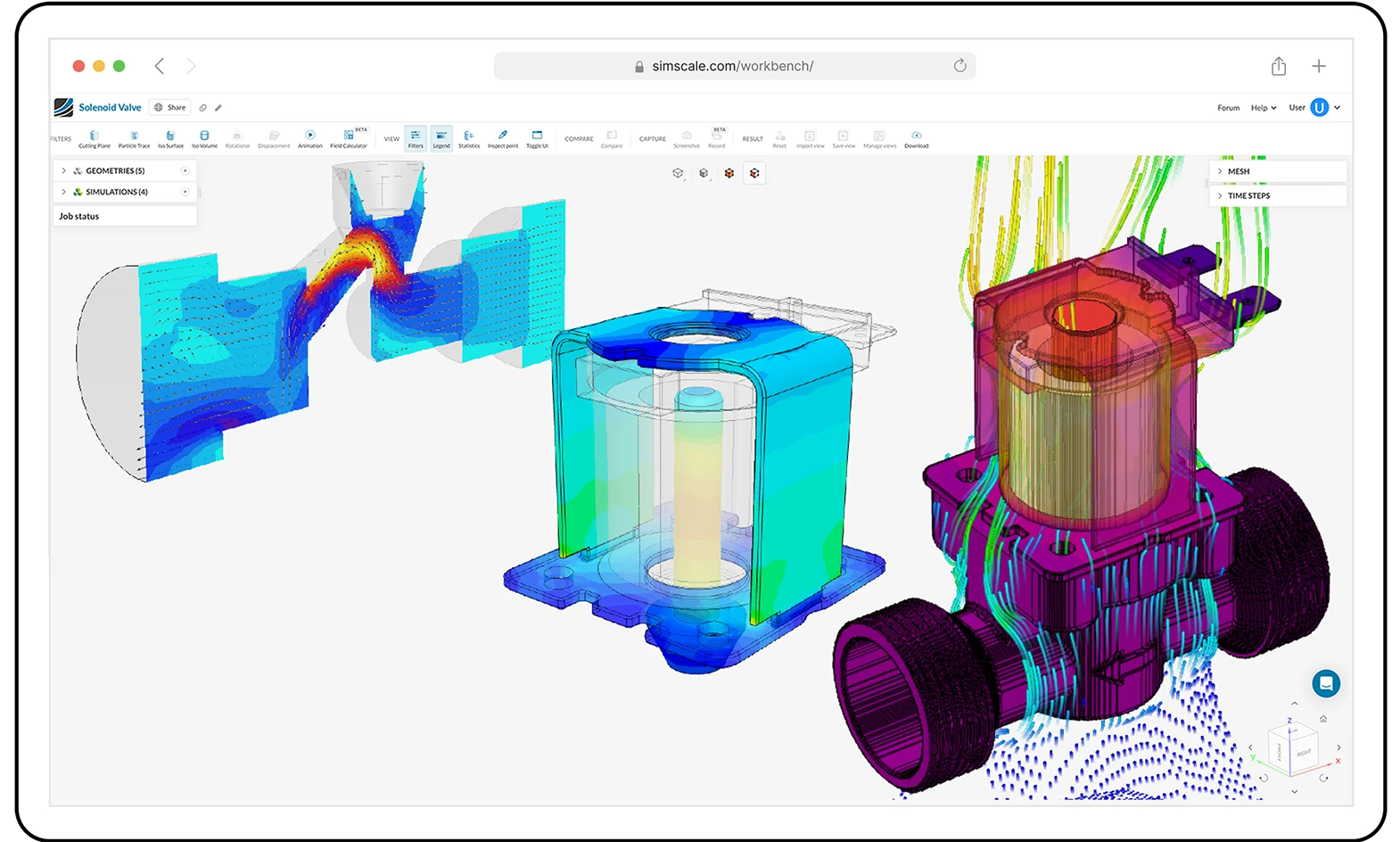
SimScale user interface
The competitive vector SimScale is pursuing is access extension, not performance competition. When browser-based access removes the hardware requirement and the local installation step, the pool of potential simulation users changes. Product teams in manufacturing and industrial organisations that have not historically budgeted CFD licences for non-specialist engineers represent the addressable population SimScale is explicitly targeting.
STAR-CCM+ and the Workflow Layer
Simcenter STAR-CCM+ has not undergone a documented interface redesign since the 2022 analysis. Its established object outline and visualisation window layout remain unchanged. What has changed is the workflow automation layer: GPU-accelerated simulation, Java macro replay for process automation, and integration within the Simcenter X SaaS entitlement bundle, which changes how users access and manage the software without altering the in-application interface.
This distinction matters for product teams evaluating the competitive landscape. Interface coherence and workflow automation are different problems. A product that runs significantly faster while maintaining the same navigation complexity is not reducing the 80% preprocessing cost. It is reducing the 20% simulation runtime. The gains are real; they compound on top of an unchanged interface cost structure.
Where Sense Decay Is Visible
For products where evidence is insufficient to confirm interface changes since December 2022 (HELYX, in:Flux, SolidWorks CFD module, Phast 3D, PipeSim, Altair CFD, SimulationX), the pattern documented in 2022 continues to hold: interface complexity accumulates without structural rethinking.
HELYX's geometry view was described in the 2022 analysis as appearing cluttered and overwhelming despite a modern visual approach, a spacing failure that makes the interface feel harder than it is. in:Flux documented two parallel input patterns (an "Add item" tab and a Properties window) with visible inconsistencies in format and purpose between them. SolidWorks' icon-only tab navigation remains a documented practitioner complaint through 2025.
Individually, each of these is an addressable design problem. Together they are a description of sense decay: the point at which accumulated local decisions, each defensible in isolation, have eroded the overall coherence of the system. A cluttered geometry view, duplicate input patterns, and unlabelled tabs make a product harder to learn, harder to hand off to a less experienced engineer, and harder to defend in a competitive evaluation against a cloud-native product with a rationalised workflow tree.
Across technical software engagements, the pattern we encounter most consistently is this: the interface decisions that create sense decay are rarely made at once. They accumulate across product generations, each release adding a panel or a tab or a context menu to accommodate a new feature without asking whether the overall navigational model still serves the engineer's actual sequence of work. The cost is invisible until a competitor structures things differently and users notice.
The problem is not new to this category. Our work with Gexcon on their explosion and fire simulation tooling documented exactly this trajectory: an expert-user CFD product built for a generation of practitioners whose successors were gravitating toward simpler alternatives, with the interface increasingly dependent on accumulated individual knowledge rather than discoverable structure. The full case study illustrates the point at which interface debt in technical software becomes a strategic question rather than a maintenance task.
Experts Don't Care About UX
The persistent assumption in this product category is that expert users absorb interface complexity as professional competence. CFD engineers have always had steep learning curves. The tools have always been hard. Expertise means having learned to work around the friction.
This assumption misidentifies what expertise costs.
An experienced CFD engineer who has learned to navigate a cluttered geometry view, manage two parallel input patterns, and avoid the toolbar sequences that produce unexpected results has invested time and attention in understanding the interface's idiosyncrasies. That investment sits as a recurring tax on every new project, every team member who needs onboarding, and every engineer who could perform simulation work but has not cleared the knowledge barrier to the tooling.
The practitioner who described selecting a CFD tool early in his career for an obscure feature that was never used, while the "clunky day-to-day workflow cost hours," captures the commercial reality directly (visualfoodie.com, January 2026). He was expert enough to make the tool work. The tool still cost him hours. Expertise absorbs the cost of bad interface design; it does not eliminate it.
The Navier AI founding thesis adds a harder signal. When a Y Combinator-backed startup positions its entire market opportunity on the claim that engineers prefer building physical prototypes to running simulations because the simulation tools are too hard to use, the implication is not that some users have a UX preference. The implication is that the category is losing potential simulation volume to an alternative that has no software friction at all.
What the Patterns Reveal
Across the products reviewed, two positions are emerging in the competitive landscape.
The first treats the interface as infrastructure. ANSYS is investing in cross-product design language standardisation, embedded AI documentation, and a web client for expanded access. SimScale has restructured its workflow model to match the engineer's decision sequence rather than the software's internal architecture. Both are treating the question of who can use simulation, and how efficiently, as a strategic product question.
The second treats the interface as a stable variable while investing in solver performance and workflow automation. This is a defensible position for the engineering core of a simulation product. It is not a defensible position when cloud-native competitors are redefining the access economics of the category.
The comparison table below maps the reviewed products against the four dimensions of the Workflow Integrity Standard.
| Product | Navigation Coherence | Workflow Continuity | Constraint Transparency | Capability Gradient |
|---|---|---|---|---|
| ANSYS Fluent | Improved (ADL, 2024) | Partial (Discovery gap persists) | Improved (CoPilot, 2025) | Strong |
| SimScale | Strong (workflow tree, 2023 onwards) | Strong | Moderate | Strong |
| STAR-CCM+ | Unchanged | Strong (macro automation) | Unchanged | Moderate |
| HELYX | Weak (cluttered geometry view) | Insufficient evidence | Insufficient evidence | Weak |
| in:Flux | Weak (duplicate input patterns) | Insufficient evidence | Insufficient evidence | Weak |
| SolidWorks CFD | Moderate | Unchanged | Unchanged | Moderate |
| Altair CFD | Insufficient evidence | Insufficient evidence | Insufficient evidence | Insufficient evidence |
| Phast 3D | Insufficient evidence | Insufficient evidence | Insufficient evidence | Insufficient evidence |
| PipeSim | Insufficient evidence | Insufficient evidence | Insufficient evidence | Insufficient evidence |
| SimulationX | Insufficient evidence | Insufficient evidence | Insufficient evidence | Insufficient evidence |
| ParaView | Insufficient evidence | N/A (post-processing) | Insufficient evidence | Moderate |
New entrant signals: Navier AI targets preprocessing elimination through AI-managed geometry cleanup, meshing, and solver configuration; Neural Concept's surrogate model partnership with RWDI reduced aerodynamic iteration from 10 hours to 2 minutes per cycle as of January 2026; SimScale's AI agent drives workflow automation within the existing platform.
Implications for Product Directors
Three structural conclusions follow from this review.
The preprocessing time problem is an interface problem, not a solver problem. 80% of engineering time spent on preprocessing is not reduced by faster simulation runs. It is reduced by changing what engineers spend those hours doing. Products that automate geometry cleanup, guide engineers through meshing decisions, and communicate capability constraints before setup time has been invested are addressing the real cost. Products investing only in solver speed are not.
Access extension is the underexplored competitive vector in this category. When 15% of Bühler's engineering population can access CFD through a browser without hardware prerequisites, the relevant question is not whether those engineers are as capable as dedicated CFD specialists. It is whether they can run simulations they currently do not run. New simulation volume created by access extension does not come from existing users. It grows the case for simulation investment across the organisation.
The expert wall is a product risk, not a usability concern. When experienced CFD engineers retire or move roles, the institutional knowledge they hold about a product's idiosyncrasies leaves with them. If usability depends on accumulated individual knowledge rather than interface structures that can be discovered by a new user, the product is structurally dependent on personnel continuity. That risk compounds with scale.
Establishing what current CFD tooling is actually costing in engineering time requires evidence gathered in operational conditions, not self-reported estimates or support ticket volume. User research in live engineering environments produces the kind of evidence that survives scrutiny when interface investment decisions need defending internally.
CFD software interface quality is a competitive positioning question. Product teams that treat the interface as infrastructure are pursuing a trajectory measured in how many engineers can use simulation and how much of their time is spent on simulation rather than on the overhead of accessing it. The preprocessing cost gap is where that competition is decided. It is decided by interface design, not by solver architecture.
CFD software UX is a positioning problem as much as a design problem. Products that close the preprocessing cost gap will capture simulation time that is currently being spent on mesh repair, geometry cleanup, and context-menu navigation. That time does not disappear when it is no longer spent on interface friction; it becomes simulation runs.
Limits and Gaps
This review is constrained by the evidence available in open sources. For HELYX, in:Flux, Phast 3D, PipeSim, SimulationX, and Altair CFD, insufficient public documentation exists to confirm whether interface changes have occurred since December 2022. Workflow Integrity Standard assessments for these products reflect their last documented state, not their current one.
The 80% preprocessing time figure originates from Cadence, a company with a direct commercial interest in that number being accepted. It is cited widely without challenge, suggesting practitioner recognition, but has not been independently validated to this review's knowledge. Treat it as an order-of-magnitude indicator rather than a precise benchmark.
Practitioner frustration accounts from Capterra are individual perspectives from users of unknown seniority, role, and organisational context. They are indicative, not representative.
The conclusions apply most directly to organisations where CFD simulation is performed by a defined engineering population across a defined set of simulation types. Organisations running highly specialised physics simulations on custom configurations may find the constraint transparency dimension of the Workflow Integrity Standard less predictive of their cost structure than it is in general-purpose simulation contexts.
What remains open: whether AI-agent integrations in ANSYS, SimScale, and the new entrants will materially improve constraint transparency or create a new category of sense decay as engineers learn to work around the limitations of AI-assisted workflows. That question cannot be resolved from 2026 data.
Conclusion
The CFD software interface landscape is dividing along a structural line. On one side, products are treating interface quality as a product strategy question: restructuring workflow models to match engineering decision sequences, standardising interaction conventions across product suites, and building access extension into the product roadmap. On the other, products hold the interface stable while investing in solver physics and automation at the workflow layer.
This division matters for product directors because the commercial case for simulation depends on simulation being used. When Navier AI can credibly attract Y Combinator investment on the diagnosis that engineers prefer physical prototyping to simulation, the market signal is not that simulation tools need to run faster. It is that they need to be accessible to more engineers, for more of the design decisions that currently bypass simulation entirely.
The Workflow Integrity Standard introduced in this review offers a practical frame for assessing where current tooling sits in this landscape and where gaps between interface complexity and engineering workflow are costing simulation time that never runs. The original 2022 pattern analysis, which documented the interface conventions across this product set before the changes described here occurred, is available in the Creative Navy Lab.
FAQ
What is the cost of poor UX in CFD software for engineering organisations? Poor UX in CFD software concentrates its cost in preprocessing, not in simulation runtime. Up to 80% of engineering time in CFD workflows is spent on geometry cleanup, boundary condition setup, and meshing rather than on simulation itself, according to Cadence Fidelity documentation from 2023 to 2025. Solver speed improvements do not address this cost. A Honda Motor Co. deployment of automated meshing tooling reduced preprocessing lead time and work hours by more than 90%, which indicates the scale of what interface-level improvements can reclaim.
Which CFD software has changed its interface most since 2022? ANSYS Fluent and SimScale have made the most documented and structurally significant changes in the period to March 2026. ANSYS introduced the Ansys Design Language for cross-product interaction consistency, dark mode, a browser-based web client for remote access, and an integrated AI documentation assistant. SimScale restructured from a three-tab layout to a single top-to-bottom workflow tree and added AI-driven surrogate models. Both changes address identified operational problems. The remaining products reviewed showed insufficient public evidence of comparable interface changes.
What does the Workflow Integrity Standard evaluate in CFD interfaces? The Workflow Integrity Standard assesses CFD software across four dimensions: navigation coherence (does the structure reflect the CFD process rather than the software architecture?); workflow continuity (can engineers progress without restarting or switching tools mid-setup?); constraint transparency (does the interface communicate its own limits before setup time is spent?); and capability gradient (can the product serve both experienced and transitioning engineers without sacrificing usability for either?). The standard surfaces operational interface costs rather than visual or aesthetic quality.
Are cloud-based CFD tools now competitive with desktop applications in 2026? SimScale explicitly claims performance parity with desktop applications as of its 2025 releases. ANSYS introduced a browser-based light client for Fluent in 2024 R1. The Bühler Group case study confirmed that SimScale deployment extended CFD access to 15% of mechanical and process engineers across 25 departments. Whether cloud tools are competitive for all simulation types depends on physics complexity and mesh scale. For access extension to non-specialist engineers, the cloud model has a structural advantage that desktop licensing and hardware prerequisites cannot replicate.
What does the expert wall risk mean for CFD product teams? The expert wall is the accumulated individual knowledge required to operate a CFD tool effectively, knowledge that is not encoded in the interface but held by experienced practitioners. When those practitioners leave or move roles, the knowledge leaves with them. For products where usability depends on individual expertise rather than discoverable interface structures, every personnel change is a capability event. For organisations managing CFD tooling across multiple teams or geographies, this risk scales with the organisation rather than diminishing as the tool matures.
What do new entrants like Navier AI signal about the CFD market in 2026? Navier AI, founded by former SpaceX engineers and backed by Y Combinator, positions its market opportunity entirely on the failure of legacy CFD UX to retain engineering users. Its founding thesis, that engineers prefer building physical prototypes to running simulations because the tools are too hard to use, reflects a practitioner reality corroborated independently in reviews, practitioner accounts, and usage patterns. New entrants entering specifically to exploit this gap signal that the interface problem in CFD is large enough to sustain venture-backed competition, not just practitioner frustration.
References
Ansys. (2024, June). Ansys Design Language and cross-product UX standardisation. Ansys Blog. https://www.ansys.com/blog
Ansys. (2025, July). Next-generation technology driving the CFD industry: GPU acceleration and solver benchmarks. Ansys Blog. https://www.ansys.com/blog
Cadence Design Systems. (2025). Fidelity CFD: Automated geometry preprocessing, AutoSeal, and meshing workflows. Cadence product pages. https://www.cadence.com/en_US/home/tools/system-analysis/computational-fluid-dynamics.html
Market Intelo. (2025, September). CFD software market research report 2025. Market Intelo. https://www.marketintelo.com
Navier AI. (2026). Company profile. Y Combinator. https://www.ycombinator.com/companies/navier-ai
Neural Concept. (2026, January). RWDI partnership: AI-powered CFD reduces aerodynamic analysis from 10 hours to 2 minutes. Neural Concept Blog. https://www.neuralconcept.com/blog
Ozen Engineering. (2025, July). Ansys 2025 R2 Fluent: CoPilot AI assistant and feature summary. Ozen Engineering Blog. https://www.ozeninc.com/blog
Siemens Digital Industries Software. (2025, October). Simcenter STAR-CCM+ 2510 release highlights. Siemens Blog. https://blogs.sw.siemens.com
SimScale. (2025). Bühler Group case study: Extending CFD and FEA access across 25 departments. SimScale. https://www.simscale.com
SimScale. (2025, September). SimScale summer 2025 product update. SimScale Blog. https://www.simscale.com/blog
SimuTech Group. (2024, February). Ansys 2024 R1: Interface updates and dark mode. SimuTech Group. https://www.simutechgroup.com
Visualfoodie. (2026, January). The definitive CFD software list for 2026. https://www.visualfoodie.com
In this story
A 2026 benchmarking review of CFD software interfaces across ANSYS Fluent, SimScale, STAR-CCM+, and eight other tools. Assesses each against the Workflow Integrity Standard and identifies the competitive divide between products treating UX as infrastructure and those holding the interface stable while investing in solver performance.