This article draws on Creative Navy's project work in industrial and embedded interface design, spanning industrial robots, plant floor equipment across food, pharmaceutical, chemical, and materials manufacturing, industrial automation and control software, CAD/CAM systems, IoT platforms, and simulation software. Our work in this sector covers control room environments, plant floor operations, clean room manufacturing, and field deployment conditions: designing for process engineers, plant operators, maintenance technicians, and automation engineers. We work within the standards frameworks that govern these environments, including ISA-101 for HMI design, ISO 13849 and IEC 62061 for machinery safety, and IEC 61508 functional safety requirements, treating these as structural inputs to the design process rather than compliance checklists.
Unscheduled downtime costs the automotive industry $2.3 million per hour, a figure that has climbed 62% since 2019 (Siemens/Senseye, 2024). The interfaces operators use to prevent, diagnose, and recover from that downtime are not keeping pace.
This article benchmarks seven major line control and HMI platforms used in automotive manufacturing: Siemens SIMATIC S7-1200 G2, Siemens SINUMERIK Operate, Rockwell FactoryTalk Optix, Beckhoff TwinCAT, FANUC iHMI and iHMI2, Yaskawa DX200 and YRC1000 Smart Pendant. We evaluate each against three operational dimensions that the standard vendor demonstration never tests: fault recovery under pressure, cross-tool and cross-site deployment workflow, and interface performance across a full shift length. We call this the Operational Depth Test.

Automotive line user interface
The article is written for product directors and senior programme managers who own line control systems in automotive manufacturing. It assumes familiarity with the platforms and does not rehearse vendor feature lists. The argument it makes is specific: the competitive gap in this landscape is not between platforms that look modern and those that look dated. It is between organisations that measure UX against the full operational range and those that measure it against the guided daily operations path every major vendor tests in controlled conditions.
Key statistics
- $2.3 million: cost per hour of automotive production downtime (Siemens/Senseye True Cost of Downtime, 2024)
- 62%: rise in unscheduled downtime costs for the world's top 500 manufacturers since 2019 (Siemens/Senseye, 2024)
- 70%: proportion of industrial incidents where poor HMI design is identified as a contributing factor (ASM Consortium, as cited in PLCProgramming.io, 2025)
- 30 minutes: claimed first-programme time for Universal Robots PolyScope, the cobot platform now setting the baseline expectations new operators carry when they encounter traditional line control systems
- 90 seconds: additional boot time introduced by the original FANUC iHMI layer in older installations, running on a separate embedded Windows computer above the base CNC control
The Operational Depth Test
Every platform benchmarked here performs well in the scenario a vendor engineer sets up to show a production director: guided workflow, clean data, no legacy constraints, no mid-shift fault. The performance gap appears when the scenario changes.
The Operational Depth Test evaluates a line control interface across three questions. First: how does the system behave when something goes wrong mid-shift, and how long does it take an operator to identify and recover from a non-standard fault? Second: what happens when an engineer pushes a change across multiple sites or legacy system versions? Third: what does the interface demand of an operator at hour eight of a shift compared to hour one?

Industrial automotive control unit design
These questions describe Monday through Friday in any automotive plant. They are almost entirely absent from published platform comparisons. This benchmarking review treats them as the primary evaluation criterion.
Siemens: Power with Interface Debt
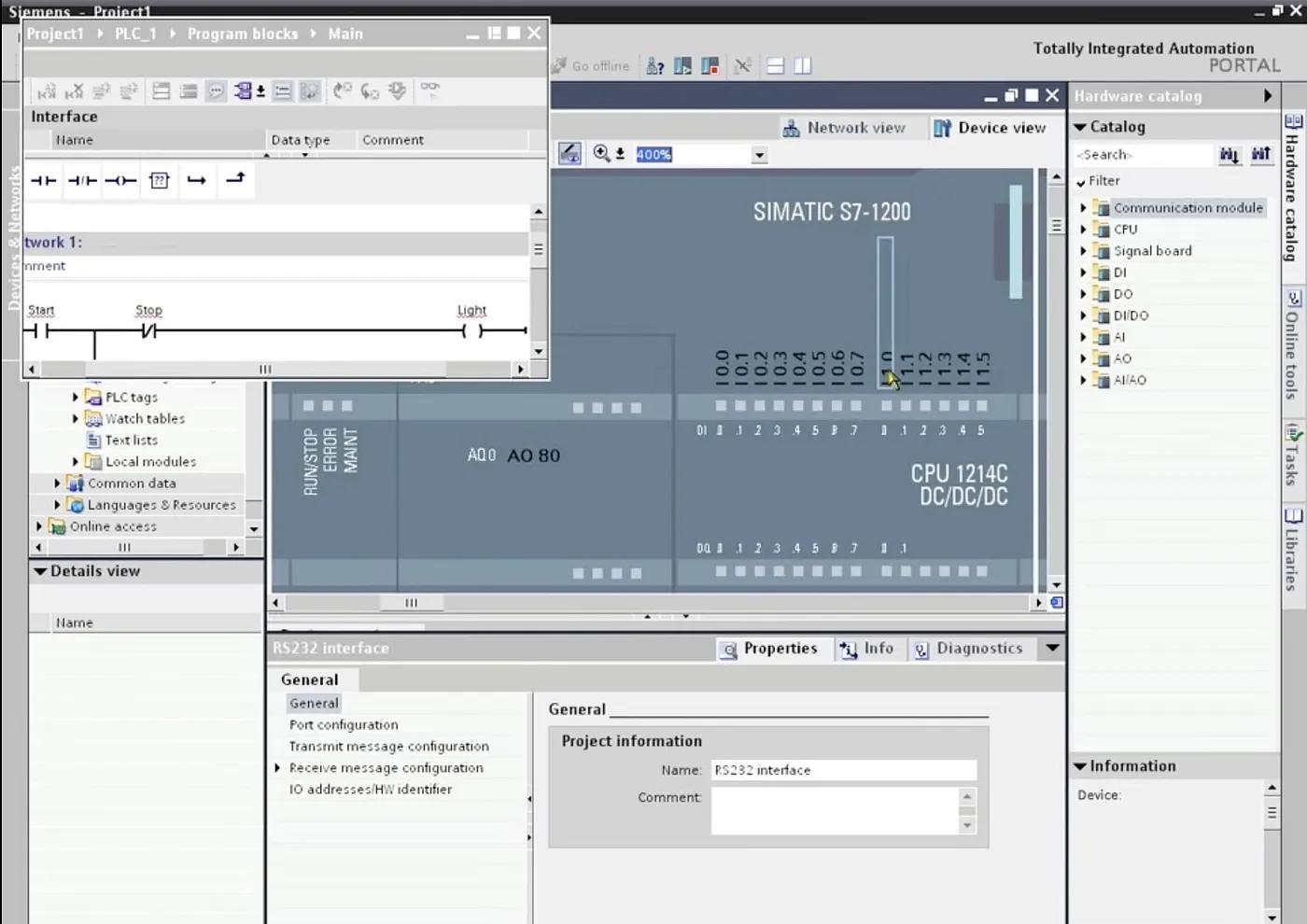
The SIMATIC S7-1200 G2, released alongside TIA Portal V20 following its Hannover Fair 2024 announcement, adds genuine capability. NFC for mobile diagnostic access, doubled bit processing performance, and safety functionality integrated without a separate licence purchase are all material improvements at the hardware level.
The engineering environment debt was not addressed in the same cycle.
TIA Portal's cross-reference limitation has been present since version 11 and persists through V20: engineers cannot trace where a variable is used through function block or function interfaces. In a troubleshooting context, this forces manual workarounds to reconstruct variable origins. On a line where every hour costs $2.3 million, extended diagnostic time from a navigation limitation has a calculable cost that recurs on every non-standard fault event.
The data loss risk during project downloads compounds this. TIA Portal's default behaviour can overwrite current online values when an engineer downloads an updated data block to a live controller, unless the engineer explicitly prevents it. This is a routine operation requiring a non-routine precaution every time. The version fragmentation problem adds a third layer: engineers managing installations across multiple client sites with different TIA Portal versions maintain parallel project copies because downward compatibility is not guaranteed. Each version boundary is a point where tacit knowledge about the system breaks down and verification work adds no direct value.
This is sense decay at the system level: accumulated interface decisions that individually seem manageable but collectively erode the operational coherence practitioners depend on. The Industrial Copilot AI assistant, layered over TIA Portal at Hannover Messe 2024, addresses code generation speed for engineers. It does not address the cross-reference limitation or the download behaviour.
The S7-1500 receives the same TIA Portal improvements but has seen no independent UX development since late 2023. SINUMERIK Operate remains structurally unchanged.
FANUC iHMI2: Surface Over Structure
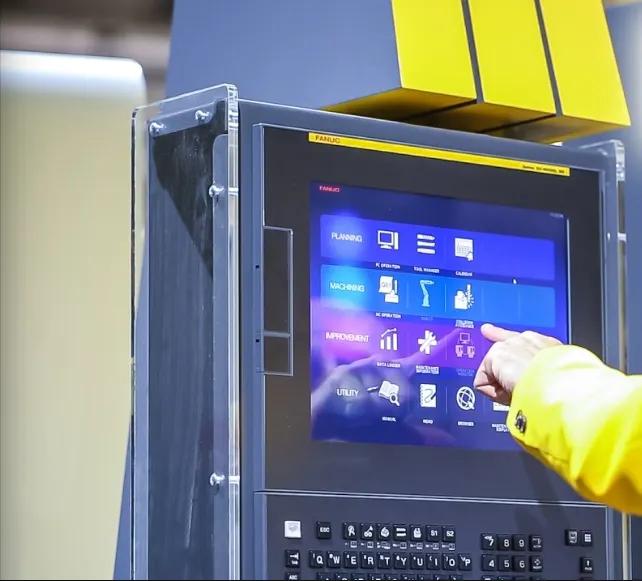
FANUC's iHMI2, unveiled at IMTS 2024, introduces one architectural claim worth examining carefully: a 1-to-1 task-to-screen layout, designed to eliminate the mode-switching that forced operators between screens for standard daily operations. That is a structural decision, not a cosmetic one.
The scope of that decision is the problem.
The original iHMI ran as an embedded Windows computer bolted above the base FANUC control, adding 90 seconds to boot time and capable of crashing independently of the underlying CNC. It covered standard daily operations. It covered fault recovery, parameter management, and advanced programming not at all. Operators who needed anything outside the standard flow stepped out of iHMI entirely and back into the base FANUC parameter interface. Practitioners working with that interface in production have compared it to the Apollo Guidance Computer's table of numbers and bits: unchanged from the 1980s in its conceptual model.
iHMI2's task-to-screen architecture improves the guided daily operations path. The research available from IMTS 2024 does not confirm whether the deeper interface layers were redesigned in the same cycle. If they were not, the improvement applies to the workflow a first-time user encounters in a demonstration, not to the workflow an experienced operator encounters at 3am with a stopped line.
FANUC formal training programmes for basic robot operation span one-week certification courses at minimum. The training requirement itself is a measure of interface complexity: systems requiring structured third-party certification to operate competently carry an onboarding cost that alternatives without that requirement do not.
Rockwell FactoryTalk Optix
FactoryTalk Optix is the most structurally significant platform shift in this benchmark set. Rockwell launched it in October 2023, released version 1.2 at Automation Fair in November 2023, and has published quarterly updates through 2024 into 2025. The OptixPanel hardware line replaces the PV800 form factor for new deployments. The platform is browser-accessible, cloud-enabled, with OPC UA supporting deployment to both Rockwell and third-party hardware.
The declared direction is not ambiguous: the PanelView family and its associated tooling (FactoryTalk View Studio, Connected Components Workbench) is the migration-away-from platform. Optix is the path forward. For organisations with existing PV800 installations, nothing has changed. Those systems received no UX updates. For new deployments, the competitive landscape has changed structurally.
Optix's browser-based architecture changes the constraint profile in ways that matter for automotive production directors. Centralised deployment updates rather than per-device touchpoints; hardware-agnostic visualisation that reduces lock-in to a single form factor vendor; design and runtime separation that allows engineering changes without production interruption. These are constraint-respecting decisions: they acknowledge the real cost structure of maintaining distributed HMI estates across multi-line facilities. Transitioning a complex installed base out of legacy toolchains without disrupting production is the kind of structural question Optix is designed for; the platform's architecture at least makes it answerable.
The migration liability is equally real. Every organisation that has built significant display libraries, alarm configurations, and workflow screens in FactoryTalk View Studio now carries a project reconstruction cost. FactoryTalk View to Optix is not a straight port. That liability does not appear in a platform comparison. It becomes visible when a capital decision about new lines forces the choice.
Beckhoff TwinCAT: The Opacity Problem
TwinCAT 3.1 Build 4026, released in 2024, introduced improvements practitioners had requested for years: improved cross-reference lists with usage context columns, drag-and-drop support for the CFC editor, and Visual Studio 2022 support for a 64-bit engineering environment. For complex multi-axis automotive programmes previously constrained by the 32-bit memory ceiling, the last item is a real capability gain.
The opacity problem runs alongside them.
Beckhoff does not publish official release notes for TwinCAT. A community-maintained changelog exists on GitHub because practitioners deploying to production machines cannot otherwise audit what changed between versions. One prominent TwinCAT practitioner with a significant community following described this absence as the single highest-priority improvement they would request, for a specific operational reason: the inability to know what changed between versions introduces uncontrolled risk when deploying to machines where an undocumented behaviour change could stop production.
The stability evidence points the same direction. A documented practitioner account describes a client who schedules weekly machine restarts to prevent latency and communications issues that accumulate during continuous operation. A scheduled restart is a constraint on production availability. It is the operational consequence of a system that has not been designed to sustain coherent behaviour across uninterrupted working weeks.
For the automotive production director, TwinCAT's engineering environment advantages are genuine, particularly for demanding motion control applications. The engineering team working with it carries an ongoing uncertainty cost that Siemens and Rockwell, with their published changelogs, do not impose in the same form.
Yaskawa: The Legacy Transition
The DX200 is no longer a current-generation product. Yaskawa's YRC1000 and YRC1000micro are the active platforms. The Smart Pendant, available for YRC1000 controllers, offers a substantially modernised interface: touch-based, with a simplified programming workflow compared to the DX200 pendant. DX200 documentation received updates in March and August 2024, but no UX development is active on the platform.
The DX200 remains in deployed service across active automotive facilities. Practitioners working across multiple robot brands have documented a specific operational friction in the Yaskawa offline programming workflow: there is no overwrite option when deploying an updated programme to the pendant. The engineer must manually delete or rename the existing programme before the download proceeds. This reintroduces exactly the production downtime that offline programming was designed to eliminate.
The Smart Pendant's modernised interface does not retrofit to DX200 hardware. Organisations running mixed fleets, which describes most large automotive facilities, carry that workflow friction on every DX200 installation while running the newer pendant model elsewhere. The operational inconsistency is a training and error-rate problem as much as a UX problem. Operators calibrated to one interaction model who switch to another within the same shift carry a cognitive load that does not appear in any product specification.
What the Patterns Reveal
Three patterns are consistent across these seven platforms.
The demonstration gap is the first. Every platform performs well in the scenario a vendor engineer sets up: guided workflow, clean data, no legacy constraints. The research on how these platforms behave in fault recovery, in version-mixed deployments, and over a full eight-hour shift tells a different story. The FANUC iHMI surfaces standard operations smoothly and leaves the recovery path structurally unchanged. TIA Portal's download behaviour and cross-reference limitation are invisible in a scheduled demo. The DX200 overwrite problem only appears when a practitioner is deploying offline code to a live machine under production pressure.

Industrial HMI interface
The layering response is the second. When incumbent platforms face usability pressure, the consistent response is a new layer above the existing architecture. FANUC iHMI was added above the base CNC. The Siemens Industrial Copilot is added above TIA Portal. Layering preserves existing investments and avoids migration cost. It also preserves the architectural friction that made the layer necessary, compounds system complexity, and adds new failure modes. The iHMI crash mode documented by practitioners, independent of the underlying CNC, is a direct consequence of layering: a system that can fail without the base system failing, but cannot recover without operator intervention at both levels.
The cobot reference point is the third. Universal Robots' PolyScope, with its claimed 30-minute time-to-first-programme, and Doosan Dart-Suite's app-like deployment model are now the baseline expectations new engineers carry when they encounter traditional line control interfaces. The engineers entering automotive facilities today learned on systems that feel nothing like SIMATIC S7-1500 or the DX200 pendant. The training budget and error-rate premium for traditional interfaces is rising as the population trained natively on those platforms shrinks.
| Platform | Fault Recovery Path | Deployment Workflow | Shift-Length Coherence | Structural Change Since 2023 |
|---|---|---|---|---|
| Siemens S7-1200 G2 / TIA Portal | Cross-reference gap persists through V20 | Version fragmentation; downward compatibility not guaranteed | UI bloat; screen real estate friction reported | Hardware improved; UX debt unchanged |
| Siemens SINUMERIK Operate | No material change | No material change | Unchanged | None confirmed |
| Rockwell FactoryTalk Optix | New platform; migration liability from View Studio | Browser-based deployment; hardware-agnostic | Improved architecture for new deployments | Structural: new platform direction |
| Beckhoff TwinCAT Build 4026 | Opacity of changes creates uncontrolled deployment risk | No release notes; community changelog required | Weekly restart workaround documented | Iterative engineering improvements only |
| FANUC iHMI2 | Deeper layers unchanged from base FANUC | Unchanged | iHMI layer can crash independently of CNC | Task-to-screen architecture for standard ops only |
| Yaskawa DX200 | Not a current-generation platform | Overwrite gap in offline-to-online deployment | Inconsistency across mixed DX200 and YRC1000 fleets | None; maintenance support only |
| Yaskawa YRC1000 Smart Pendant | Modernised for YRC1000; does not retrofit to DX200 | Improved over DX200 baseline | Touch-based; simplified programming workflow | Structural for new deployments |
Better UX Won't Fix Bad Architecture
The counterposition common in this market is that surface-level interface improvements, including better visual hierarchy, cleaner alarm presentation, and updated touch targets, address the usability problem. The evidence from these platforms argues otherwise.
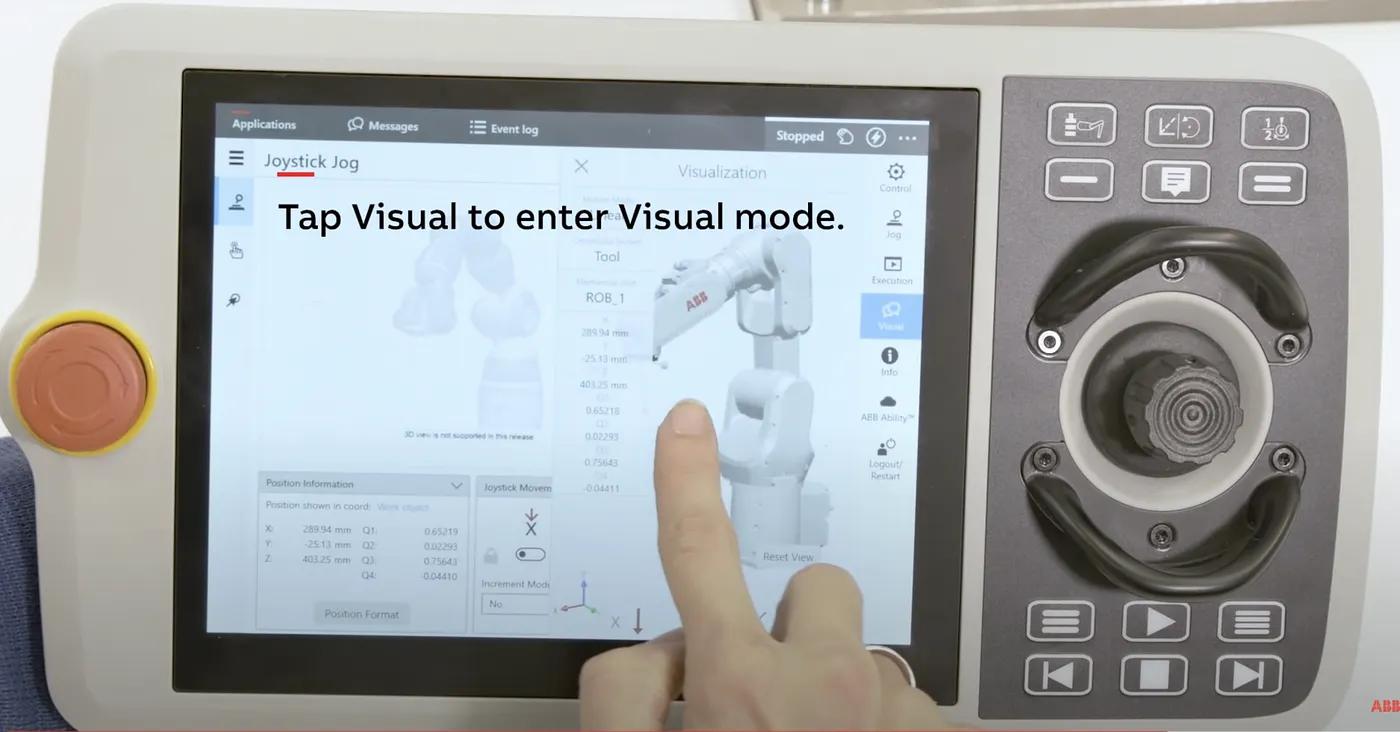
FANUC iHMI2's 1-to-1 task-to-screen redesign is the clearest test. It is a genuine structural improvement for the operations it covers. It does not change the architecture of what it does not cover. Practitioners who need to manage parameters, recover from non-standard faults, or reach the layers of the FANUC system that iHMI was never designed to address still encounter the original interface model.

Automotive HMI design
The same test applies to TIA Portal's visual improvements across V18, V19, and V20. The cross-reference limitation, present since version 11, was not addressed in those cycles. Improved visual affordances cannot substitute for a navigation capability that is absent at the moment an engineer needs it most: under production pressure, tracing an unfamiliar fault.
In our work with industrial clients, the pattern is consistent. Interface redesign that changes the appearance of a system without addressing its structural navigation model produces an initial improvement that measures well in the first month after deployment and reverts by month four. Operators re-establish the same friction points because the workflow structure that produced them was not changed. The redesign addressed sense decay at the surface. The underlying decay continued. The work on the Beissbarth automotive calibration equipment interface showed what goes into the structural level: six weeks of concurrent research and redesign, building interaction that functions correctly for technicians moving around vehicles with tools in hand, under time pressure, from 2 to 3 metres, through gloves. That is constraint-respecting design; it starts from the conditions of use and works inward, rather than starting from the visual layer and working outward.
Industrial automotive line control interfaces contribute to downtime through three mechanisms: extended fault diagnosis when interface navigation does not support recovery workflows; operator error under pressure when visual hierarchy does not distinguish critical from non-critical states; and deployment friction when engineering teams managing updates across sites encounter tool fragmentation and version incompatibility. At $2.3 million per hour of automotive downtime (Siemens/Senseye, 2024), each of these mechanisms has a direct cost that surface redesign does not address.
What Competitive Advantage Looks Like
The organisations gaining competitive advantage from HMI investment in 2026 are not those with the newest-looking interfaces. They are those that have applied the Operational Depth Test: measuring interface performance against fault recovery, multi-site deployment, and extended shift conditions rather than against the guided daily operations path.
Operationally, this means three specific investments.
Measure the recovery path, not the standard path. The metric that matters for downtime cost is not how long it takes a trained operator to complete a scheduled task. It is how long it takes to identify and recover from an unexpected fault state under shift conditions. That metric is rarely collected. Where it is collected, the gap between the standard and recovery paths is consistently wider than platform documentation implies.
Audit structural depth before commissioning surface redesign. Before investing in a visual refresh of an existing HMI estate, trace the ten most common fault recovery sequences through the actual interface navigation. If those sequences require the operator to exit the primary interface and work in an underlying system, the redesign scope needs to include the underlying system. Cosmetic work on top of structural friction prolongs the problem at redesign cost.
Cost the training premium as a recurring line. The training requirement for traditional PLC and HMI platforms is not a one-time investment. As the workforce entering automotive manufacturing has been shaped by cobot and consumer software interaction models, the gap between their baseline expectations and traditional interface models is growing. Standardised, reusable embedded GUI systems cut engineering and validation cost by 20 to 30% and shorten release cycles by two to three months (Siemens, Rockwell, Fraunhofer data cited in Lenard, 2025). The evidence on what returns embedded GUI investment generates for OEMs positions this as an infrastructure decision, not a discretionary design choice.
Organisations that treat industrial HMI design as infrastructure rather than appearance measure the full operational range before selecting or redesigning a platform. The Operational Depth Test evaluates three conditions vendor benchmarks exclude: fault recovery speed under pressure, deployment workflow across sites and system versions, and interface performance at hour eight of a shift. The platforms that perform well on all three are not the same ones that perform well in a scheduled demonstration.
Limits and Gaps
This review draws on publicly available vendor announcements, documented practitioner accounts, and platform release documentation current to March 2026. Direct comparative testing in live production environments was not conducted. Verdicts on platforms with insufficient public evidence (Bosch Rexroth IndraMotion MTX micro CNC) are excluded rather than estimated.
Three conditions where these conclusions do not hold.
Single-platform standardised estates. An organisation that has run exclusively one PLC and HMI vendor across all its lines for more than ten years will have accumulated workarounds and expertise that substantially offset the structural friction described here. The cross-reference limitation in TIA Portal is a serious problem in a mixed-tool environment; for a team that has learned to work around it on every project, it is a manageable constraint. The operational cost is real but absorbed rather than visible.
New greenfield deployments. The competitive landscape for new line builds in 2026 is materially different from the upgrade or maintenance scenario this review primarily addresses. FactoryTalk Optix, Universal Robots PolyScope, and Siemens Industrial Copilot are all better understood as greenfield options than as upgrade paths. Their limitations for organisations with legacy estates do not apply in the same way to a facility being built from scratch.
Interface as one variable among many. HMI UX contributes to downtime cost, training burden, and error rate. It does not explain them on its own. Maintenance regime, parts availability, MES and ERP integration, and shift management practices all independently affect the cost of production stoppages. An interface improvement programme that does not account for these factors will produce partial results.
What cannot yet be resolved: whether the cobot UX baseline (UR PolyScope, Doosan Dart-Suite) will remain a differentiator in automotive manufacturing or become the structural expectation for all line control interfaces within this decade. The market share trajectory is visible. The rate at which traditional platforms respond structurally rather than cosmetically is not.
Conclusion
A production director who asks their engineering team whether the HMI is fit for purpose will almost always hear yes. The engineers have adapted to it. Their expertise is partly constituted by knowing how to work around its limitations. That expertise is real and valuable, and it is also the reason the interface cost is invisible to the budget.
The $2.3 million per hour figure from the Siemens True Cost of Downtime 2024 report is not about catastrophic system failures. It is about every hour of every unscheduled stoppage, including stoppages that trace back to an operator navigating five menus to recover from a fault that a structurally different interface would have surfaced in one. Those decisions accumulate outside any line in the capital budget.
The platforms benchmarked here range from those adding genuine structural depth (FANUC iHMI2's task-to-screen architecture for the operations it covers, Rockwell FactoryTalk Optix's deployment model for new lines) to those applying new layers above structural problems that have been present for a decade or more. The Operational Depth Test distinguishes between them. It does not require a specialist assessment: it requires measuring the workflows that matter, not the workflows that look good in a demonstration.
The point at which interface drift becomes an organisational constraint rather than an operational inconvenience is where new hires cannot make sense of the system without weeks of mentorship from the engineers who built workarounds for it. That threshold is earlier than most organisations expect, and the cost of crossing it unnoticed is the same as every other form of accumulated design debt: it compounds.
FAQ
What is the Operational Depth Test for industrial HMI evaluation?
The Operational Depth Test evaluates a line control interface against three conditions vendor benchmarks exclude: fault recovery speed under shift pressure, engineering deployment workflow across sites and legacy system versions, and interface performance at hour eight of a shift. A platform that performs well in a guided demonstration but fails on these three conditions carries structural UX debt. Surface redesign will not resolve it because the underlying navigation model remains unchanged.
What changed in FANUC iHMI with the iHMI2 release at IMTS 2024?
FANUC iHMI2 introduced a 1-to-1 task-to-screen layout for standard daily operations, eliminating mode-switching between screens for common tasks. This addresses a documented friction point in the original iHMI. The underlying FANUC parameter and fault management interfaces, which the original iHMI layer did not redesign, were not confirmed as structurally changed in the IMTS 2024 announcement. The improvement is real; its depth is proportional to the scope of the redesign.
Why does TIA Portal's cross-reference limitation matter for automotive production directors?
The inability to trace variable use through function block or function interfaces in TIA Portal forces engineers to reconstruct variable origins manually during fault diagnosis. At $2.3 million per hour of automotive downtime (Siemens/Senseye, 2024), any navigational limitation that extends diagnostic time has a calculable cost that recurs on every non-standard fault event. The limitation has been present since TIA Portal version 11 and persists through V20.
What does FactoryTalk Optix mean for existing PanelView and PV800 installations?
Rockwell Automation launched FactoryTalk Optix in October 2023 as the successor direction for HMI development. Existing PV800 installations received no UX updates. New deployments use the OptixPanel hardware line. FactoryTalk View to Optix is not a straight port; display libraries, alarm configurations, and workflow screens require reconstruction. The migration liability is real for any organisation with a significant installed base of FactoryTalk View projects.
How does the cobot UX baseline affect workforce expectations in traditional automotive plants?
Universal Robots PolyScope claims 30-minute time-to-first-programme for new users. Doosan Dart-Suite positions controller operation as requiring no programming for many operations. Engineers entering automotive manufacturing with cobot experience carry these as baseline expectations when they encounter traditional PLC and pendant interfaces. The training time and error rate premium for traditional interfaces grows as this population increases and the population trained natively on traditional systems shrinks.
When does HMI interface drift become a business risk rather than a nuisance?
Interface drift crosses from nuisance to business risk when the most critical operational workflows, specifically fault recovery and multi-site deployment, require operators or engineers to exit the primary interface and work in underlying system layers that the modern interface was not designed to reach. At that point, the cost of structural redesign is high, but the cost of not redesigning compounds across every shift and every deployment cycle that follows.
References
ASM Consortium. (n.d.). Abnormal situation management research. ASM Consortium. https://www.asmconsortium.net
FANUC America. (2024). Series 500i-A CNC with iHMI2. FANUC America Corporation. https://www.fanucamerica.com
Lenard, D. (2025, October). Industrial HMI ROI: How embedded GUI design drives OEM profitability. Creative Navy. https://interface-design.co.uk/blog/industrial-hmi-roi-how-embedded-gui-design-drives-oem-profitability
PLCProgramming.io. (2025, December). HMI design best practices. PLCProgramming.io. https://plcprogramming.io
PracticalMachinist. (2024). Fanuc iHMI forum thread. PracticalMachinist.com. https://www.practicalmachinist.com
Rockwell Automation. (2024, January 22). FactoryTalk Optix version 1.3 release. Rockwell Automation. https://www.rockwellautomation.com
Roald87. (2025). TwinCatChangelog: Community-maintained TwinCAT change log. GitHub. https://github.com/Roald87/TwinCatChangelog
Sagatowski, J. (2023, May 2). TwinCAT release notes request [LinkedIn post]. LinkedIn. https://www.linkedin.com/in/jakobsagatowski
Siemens. (2024). True Cost of Downtime 2024. Siemens/Senseye Predictive Maintenance. https://www.siemens.com
Siemens. (2024). SIMATIC S7-1200 G2: Technical overview. Hannover Fair 2024 product materials. https://www.siemens.com/simatic
Yaskawa America. (2024). YRC1000 Smart Pendant. Yaskawa Motoman. https://www.motoman.com
In this story
This benchmarking review evaluates seven major automotive line control and HMI platforms against the Operational Depth Test: fault recovery under pressure, cross-site deployment workflow, and shift-length performance. Readers will understand where sense decay is visible across the landscape, why surface redesign consistently fails to close the operational gap.
- The Operational Depth Test
- Siemens: Power with Interface Debt
- FANUC iHMI2: Surface Over Structure
- Rockwell FactoryTalk Optix
- Beckhoff TwinCAT: The Opacity Problem
- Yaskawa: The Legacy Transition
- What the Patterns Reveal
- Better UX Won't Fix Bad Architecture
- What Competitive Advantage Looks Like
- Limits and Gaps
- Conclusion
- References